Logo_2000x1003px
Generic filters
Logo_2000x1003px
Generic filters
Logo_2000x1003px
Generic filters

10kHz Base Module

  • Measurement range:
    1kV/A - 10MV/A
  • Measurement bandwidth:
    10kHz
  • Source:
    Pulse> 300kHz & CW
  • Interfaces:
    USB

100kHz Base Module

  • Measurement range:
    1kV/A - 4MV/A
  • Measurement bandwidth:
    100kHz
  • Source:
    CW
  • Interfaces:
    USB, analogue voltage (BNC)

5Hz Base Module

  • Measurement range:
    1kV/A - 10MV/A
  • Measurement bandwidth:
    5Hz
  • Source:
    Pulse> 500Hz & CW
  • Interfaces:
    USB

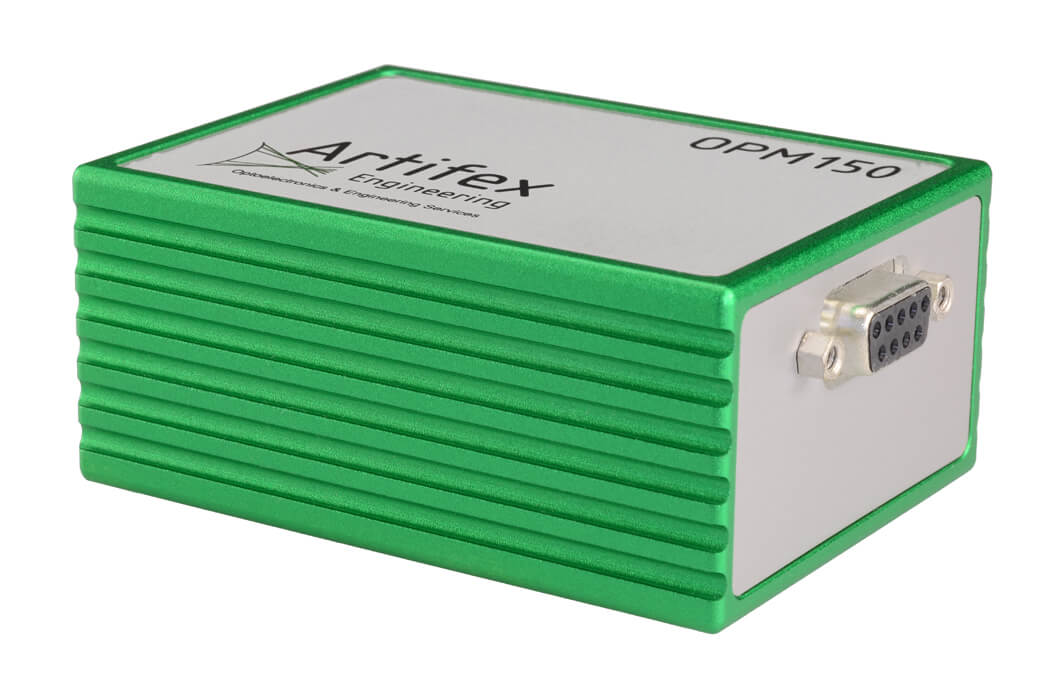
Artifex Optical Power Meter Measurement Units OPM150 is a low cost, versatile power monitor for the precise measurement of power, from nW to kW, for use in the lab and for OEM applications.

The Unit is USB powered and controlled.
A graphical user interface and a wide range of accessories make it as easy as possible to use this instrument.

Download OPM150 Broschure here – (pdf – 4MB)!

This product can be equipped with a variety of adapters and accessories for your specific application.

OPM150 10kHz Base Module

The OPM150 base module measurement units contains the electrical amplifier for the OPM150 detector heads as well as the USB communication module.

  • Measurement range: 1kV/A – 10MV/A
  • Measurement bandwidth: 10kHz
  • CW and pulsed source > 300kHz
  • Interfaces: USB

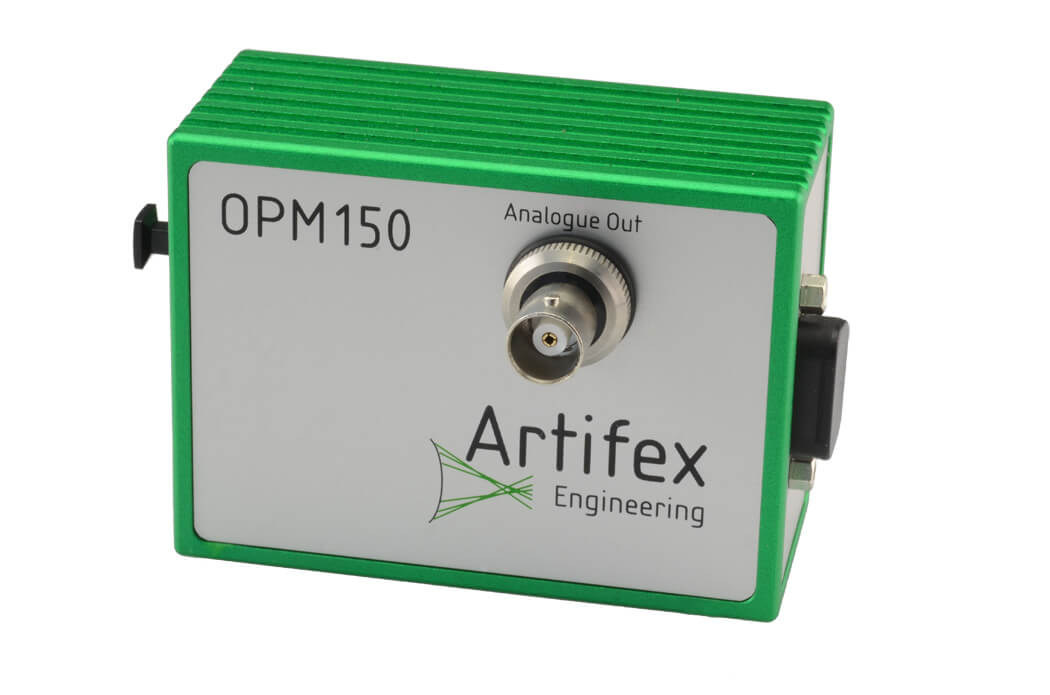
The OPM150 100kHz base module measurement units contains the electrical transimpedance amplifier for the OPM150 detector heads as well as the USB communication module. In addition, this unit has an analogue voltage output via a BNC receptacle.

However, due to its wider bandwidth, it is more sensitive to background noise than our standard base unit.

  • Measurement range: 1kV/A – 10MV/A
  • Measurement bandwidth: 100kHz
  • CW
  • Interfaces: USB, analogue voltage (BNC)

The OPM150 base module measurement units contains the electrical amplifier for the OPM150 detector heads as well as the USB communication module.

  • Measurement range: 1kV/A – 10MV/A
  • Measurement bandwidth: 5Hz
  • CW and pulsed source > 500Hz
  • Interfaces: USB
Software Development Kit

Artifex Software Development Kit

The SDK is a fixed, free component when purchasing a device.

It comes with the source code of the application program (in VB.net) and a LabView VI with the basic functions of the instrument. A description of the communication with the devices and a list of the commands used is also included.

Understanding Bandwidth and Pulse Measurement

When selecting an OPM150 optical power meter, the bandwidth of the base module plays an important role in how rapidly changing optical signals are detected and interpreted. The bandwidth determines how quickly the internal transimpedance amplifier can respond to variations in optical power, which directly influences the suitability of the instrument for continuous wave (CW) sources or pulsed laser systems.

OPM150 Pulse

To illustrate this behavior, consider a laser source operating at a pulse repetition rate of 100 kHz with a pulse width of 10 µs. The optical signal changes far faster than the measurement bandwidth of the instrument. In this situation the optical power meter cannot resolve the individual pulses of the laser. Instead, the measurement represents a response to the overall signal rather than the detailed pulse structure.

OPM150 bandwith

100 kHz Measurement Unit
– Fast Optical Power Detection

The 100 kHz measurement unit provides the highest bandwidth available for the OPM150 optical power meter. This module is designed for applications requiring rapid optical power detection and fast response to signal changes.

When measuring high-frequency pulsed lasers, the detector can respond quickly enough to detect the presence of optical pulses, but the measurement may occur at any point within the pulse envelope. Because the measurement is not synchronized to the pulse timing, the recorded value can fall anywhere between the instantaneous peak power and the time-averaged optical power. For this reason, the highest-bandwidth configuration is typically recommended for continuous wave optical power measurement rather than precise pulse characterization.

OPM150 100kHz pulse

10 kHz Measurement Unit – Averaged Measurement of Modulated Sources

The 10 kHz measurement unit offers a slower response than the 100 kHz configuration but still allows the optical power meter to follow relatively fast intensity changes. This makes it suitable for many modulated or partially pulsed optical sources where signal variations occur on moderate time scales.

When measuring very high repetition rate lasers, such as a 100 kHz pulse source with a pulse width of 10 µs, the detector bandwidth is not sufficient to resolve the individual pulse structure. Instead, the measurement electronics smooth the signal, producing an output that appears to be the average optical power delivered by the laser. In these situations, the detector behaves more like an averaging optical power meter rather than a pulse-resolved measurement device.

OPM150 10khz pulse

5 Hz Measurement Unit
– Stable Power Monitoring

The 5 Hz measurement unit is optimized for stable optical power monitoring where signal variations occur slowly over time. With a rise time of approximately 100 ms, the detector effectively integrates the incoming optical power over a relatively long time period.

Rapid fluctuations, such as those produced by high-frequency pulsed lasers, are averaged by the detector response and therefore do not appear in the output signal. Even significant variations within individual pulses have minimal influence on the measured value. This configuration is particularly well suited for continuous wave laser monitoring, optical alignment tasks, and long-term power stability measurements where a stable and noise-resistant measurement is required.

OPM150 5hz pulse

Sampling Rate vs Measurement Bandwidth

All OPM150 measurement units support a maximum sampling rate of 600 samples per second. The sampling rate determines how frequently measurement values are recorded and displayed in the software interface. For example, users may choose to log optical power data at 20 S/s for monitoring or data acquisition purposes.

It is important to distinguish this sampling rate from the internal measurement bandwidth of the detector electronics. The sampling rate controls how often measurements are recorded, while the bandwidth determines how quickly the optical power meter can respond to changes in the incoming optical signal. Selecting the appropriate OPM150 measurement unit ensures that the bandwidth of the detector matches the dynamics of the laser source being measured.

Do you need further information? Find useful links here!

Donovan Ellis

Measuring Instruments